
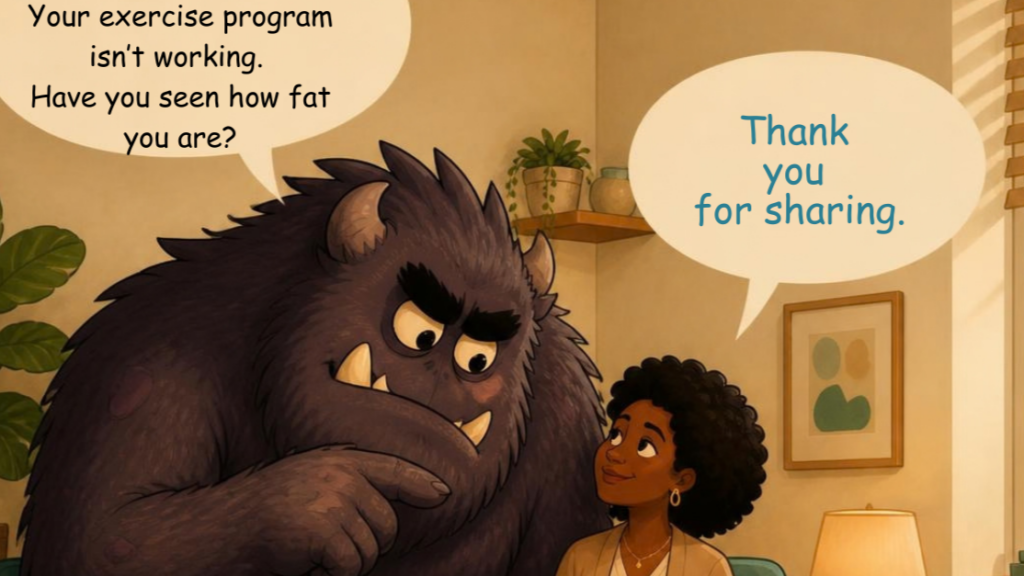
“Your exercise routine isn’t working. Have you seen how fat you are?”
This was one of eight negative thoughts that showed up uninvited and unannounced this morning at the door of my heart.
I’m pretty sure I’m not the only person who, from time to time, gets ambushed by negative thoughts. But even if I’m not the only one, today it certainly felt like I was.
When negative thoughts overwhelm us, psychology tells us to challenge them. Cognitive behavioral therapy, one of the most widely used approaches in the field, teaches us to catch the thought, examine the evidence for and against it, and replace it with something more balanced and true. In other words, put the thought on trial and make it prove its case.
I couldn’t do that.
In a course I co-coached called “Think Again,” we taught our students a technique called S.T.A.F.F.: Stop, Think, Ask, Feel, Focus. This technique is proven to help tame runaway thoughts and emotions.
I couldn’t do that either.
The thoughts were coming too fast, and they were gut-punching me with such force and accuracy that I could barely catch my breath. I was freaking out. Stressing out. For each attack-thought, I could only do two things that came instinctively, given my background in emotional intelligence:
- Write down the attack-thought.
- Write down one response – the same response – to each attack-thought.
Here are just three of the actual attack-thoughts I wrote down (and I promise you, I am not making these up), with the response I wrote next to each:
1 – The attack-thought: “Your exercise routine isn’t working. Have you seen how fat you are?”
My response: “Thank you for sharing.”
2 – The attack-thought: “You aren’t enough, not to mention how far behind in life you are.”
My response: “Thank you for sharing.”
3 – The attack-thought: “Your work doesn’t matter, because if it did, people would be coming out of the woodwork to get to you.”
My response: “Thank you for sharing.”
By attack-thought #4 (I told you, there were 8), something started happening inside my body as I kept acknowledging and writing. It was spontaneous and unexpected. I began to take a deep breath in and exhale. As my pen recorded and responded to each attack-thought, my body calmed down. I felt better with each entry. I didn’t sugarcoat the attack-thoughts. I wrote them down exactly as you see them here: raw, unfiltered, painful.
And this is the point: negative thoughts (attack-thoughts) actually feel painful.
And that’s okay.
Psychologists have a name for what I stumbled into: cognitive defusion. It comes from Acceptance and Commitment Therapy (ACT), and it means stepping back from a thought instead of wrestling with it. You notice the thought, you name it, and you let it be there without letting it run the show. ACT even has an exercise where you respond to a harsh thought with a simple “Thanks, mind.” So it turns out I wasn’t just being polite to my attack-thoughts. I was practicing psychology.
Acknowledging a thought doesn’t mean it’s true. It means it exists, and you can choose to make room for it rather than resist it, fight it, or even ignore it (only for it to attack again, loiter, and bring along its unemployed friends).
But acknowledging the attack-thoughts is only half the work.
The other half is to thank each one for serving its purpose. That purpose is to redirect you to a positive or reflective counter-response.
In the moment I was being ambushed, I had no positive thought to offer. How could I come up with a quick reflective comeback to “Your exercise routine isn’t working. Have you seen how fat you are?” when just that morning I had caught my reflection in the sliding glass door of my home and noticed more flesh than I ever wanted to see?
All I could offer in that moment was, “Thank you for sharing.”
Now that I’m calm and the attack-thoughts are quiet, I can offer a reflective counter-response that is real and true for me:
1- The attack-thought: “Your exercise routine isn’t working. Have you seen how fat you are?”
My reflective response: “I am committed to my exercise routine, and as I stay consistent, the extra weight will dissolve.”
Notice I didn’t respond that I’m not fat, because when I look at myself, in the back of my mind, I see fat. Being true to myself is what makes the response authentic.
2 – The attack-thought: “You aren’t enough, not to mention how far behind in life you are.”
My reflective response: “I have at least three friends I could call right now who would say I am enough and that I am exactly where I am supposed to be in this season of my life. In fact, I already reached out to one of them and she sent me a voice note so I’ll always remember this truth.”
3 – The attack-thought: “Your work doesn’t matter, because if it did, people would be coming out of the woodwork to get to you.”
My reflective response: “I keep a running list of testimonials from clients, my children, friends, and professionals who share the difference I make in their lives. That’s all I ever need.”
I feel better now.
I feel empowered.
I feel I can manage the rest of the day.
I feel like a winner.
Do you want to feel like a winner, too, when attack-thoughts take over?
Take the 7-day challenge. Download the free journal: “Thank You for Sharing” 7-Day Challenge Journal.
Over the next seven days, challenge yourself to write down every attack-thought. Don’t keep the attack-thoughts in your head, because if you do, they will stay there, living rent-free.
Then reply to each attack-thought with a simple written statement: “Thank you for sharing.”
Only when you feel calm and clear, go back to each attack-thought and write a reflective counter response that is real and true for you.
This challenge will take courage, because attack-thoughts can be really mean, and they can hurt your feelings.
But you already have courage inside of you, waiting to be activated.
Download the free journal and take the 7-day challenge. Then let me know how it goes. My email and contact information are included in the journal.